
When it comes to relocating a data center, the stakes couldn’t be higher. Every minute of downtime means lost revenue, operational disruption, and potential damage to your organization’s reputation. That’s why choosing experienced data center movers and applying best practices is essential for a seamless, secure, and efficient transition. With the right approach, you can protect your data, infrastructure, and business continuity, ensuring that the move strengthens, rather than threatens, your operations.
At Dan’s Van Lines, we understand the unique challenges involved in data center and server relocations throughout Alexandria, VA, and Northern Virginia. With over 25 years of professional moving expertise, our team is dedicated to providing the precision, planning, and security your business demands.
The Critical Importance of Uptime in Data Center Moves
Uptime is more than a technical metric, it’s a business imperative. When relocating a data center, even brief outages can result in substantial financial losses, regulatory complications, and lasting reputational harm. data center downtime shows that the average cost can reach $9,000 per minute, with some sectors facing losses exceeding $5 million an hour. For many organizations, a single hour offline can have consequences that stretch far beyond IT, affecting every aspect of business operations.
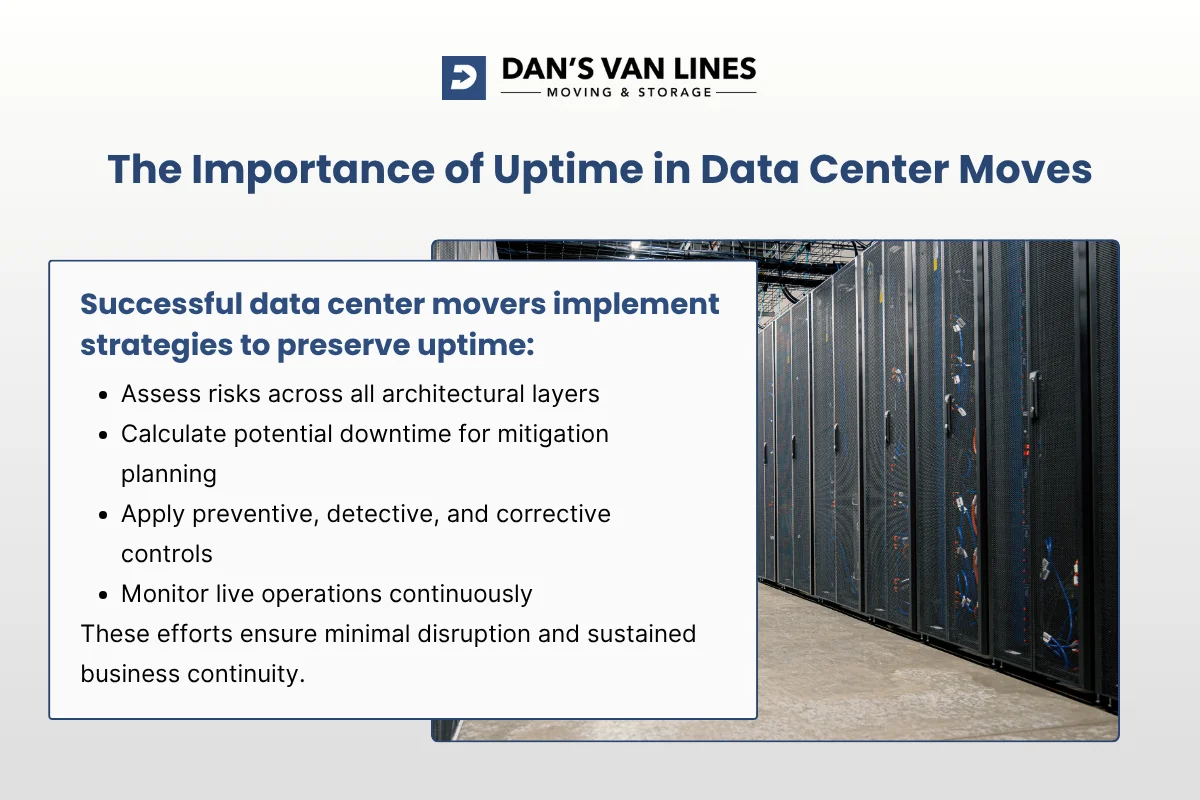
The complexity of a data center move introduces multiple risk factors: physical equipment transport, network and power redesign, and often, application re-platforming. Compounding these risks with compressed timelines can lead to human error, mis-coordination, and new points of failure. That’s why the most successful data center movers approach each project with a rigorous risk management strategy, treating uptime preservation as a core design constraint.
Protecting uptime requires a structured approach:
Evaluate and assess risks across all architectural layers, including facility, platform, application, and business process.
Calculate potential downtime to provide a strong justification for comprehensive mitigation strategies.
Apply defense-in-depth approaches by establishing preventive, detective, and corrective controls.
Continuously monitor live operations during the entire migration to ensure smooth execution.
By focusing on these principles, professional data center movers can ensure minimal disruption and maximum business continuity during relocation.
Strategic Planning: The Cornerstone of Reliable Data Center Relocation
Effective data center relocation is built on careful, strategic planning that bridges architecture, operations, and program management. The greatest risk in any move comes from hidden dependencies and unanticipated challenges. That’s why thorough discovery and dependency mapping are essential before a single server or cable is moved.
The planning process should include:
Comprehensive asset inventory and enrichment of configuration management databases (CMDB)
Mapping all application, infrastructure, and service dependencies
Classifying workloads by criticality to prioritize resources and risk controls
Relocation success depends on architectural patterns that decouple logical cutovers from physical moves. Popular strategies include phased migrations, swing infrastructure, and active-active or master/replica systems. These methods allow data and applications to remain available while physical assets are transported, tested, and brought online at the new location.
Key operational best practices for data center movers:
Schedule moves during low-demand windows to reduce business impact
Conduct rehearsals and develop detailed runbooks for each phase
Establish a command center for real-time monitoring and rapid decision-making
Prepare contingency plans, including rollback and fail-forward options
By following these disciplined planning strategies, you can dramatically reduce the probability and impact of downtime events, ensuring a controlled and successful transition.
Efficient Cabling Techniques for Seamless Data Center Relocation
Cabling is often an afterthought in many IT projects, but during a data center move, it becomes a top priority. Efficient cabling techniques not only speed up the relocation process but also lower the risk of costly errors and troubleshooting delays.
Leading data center movers use structured cabling frameworks based on industry standards such as TIA-568, TIA-942, and ISO/IEC 11801. These standards provide a blueprint for organizing cables, pathways, terminations, and labeling, transforming the data center into a modular, manageable system.
Structured cabling offers several key advantages that can greatly benefit your organization. It reduces troubleshooting and installation time by up to 60 percent, making it much easier and quicker to manage your network infrastructure. With structured cabling, the risk of mispatching and accidental outages is minimized, ensuring a more reliable and stable network environment. This approach also allows for predictable and repeatable migration of logical blocks, which simplifies upgrades and changes to your system. Additionally, structured cabling enables efficient parallel workstreams, leading to faster project delivery and smoother operations overall.
Logical cabling architectures, such as Top-of-Rack (ToR), End-of-Row (EoR), and Spine-leaf, support relocations by standardizing patterns and simplifying re-cabling. Physical cable management, including clear separation by function and careful use of bundles and trunks, makes the move more efficient and less prone to error.
Labeling Best Practices: The Backbone of Risk-Controlled Moves
Accurate labeling is critical for a successful data center relocation. Without clear, standardized labels, even the best-planned move can turn into a trial-and-error exercise, increasing the risk of downtime and mistakes.
Industry standards like ANSI/TIA-606 dictate that every cable and port must be labeled at both ends, using legible, durable, machine-printed labels. This practice makes every component addressable, traceable, and easy to restore after the move.
Essential labeling best practices for data center movers:
Label both ends of every cable, patch panel, and port to ensure clear identification throughout the network.
Use durable, machine-printed labels with standardized syntax for consistency and longevity.
Apply color coding to easily distinguish between different connection types and uses.
Integrate physical labels closely with digital asset inventories for seamless tracking and management.
High-quality labeling provides several key benefits:
Enables rapid fault isolation and troubleshooting.
Supports faster, more accurate migration and restoration processes.
Reduces the risk of human error and accidental mispatching.
Improves compliance and audit readiness for regulatory requirements.
By adhering to these standards, data center movers can ensure that every element of the move is controlled, documented, and recoverable.
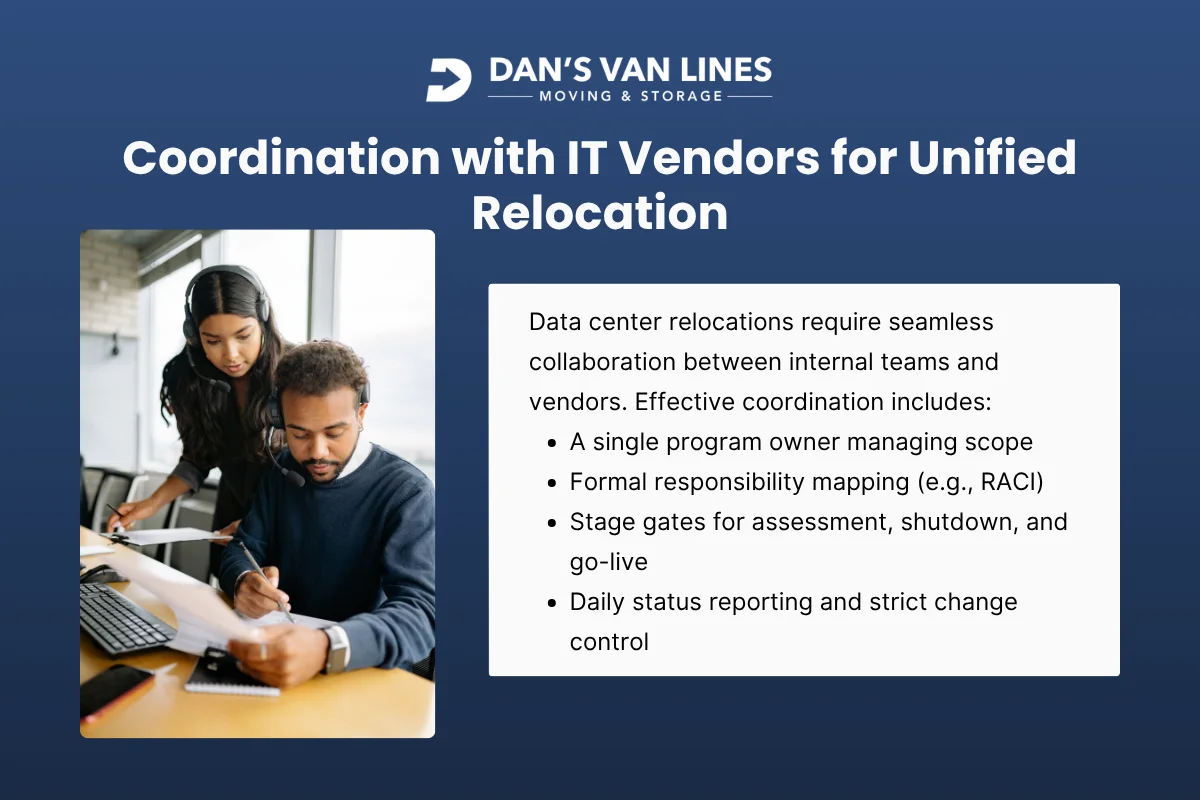
Coordination with IT Vendors: Building a Unified Relocation Team
Data center relocations are rarely handled by a single team. Success depends on seamless collaboration between internal IT, facilities, security, and multiple vendor partners. The best outcomes are achieved when all parties operate under a unified plan, with clear roles, responsibilities, and communication protocols.
A robust vendor coordination model includes:
A single program owner with authority over scope, risk, and timing
Formal responsibility mapping (e.g., RACI) for all stakeholders
Stage gates for assessment, shutdown, transport, re-rack, validation, and go-live
Daily status reporting and strict change control during move windows
Explicit exit and fallback procedures for missed milestones
Early engagement with all vendors is crucial. Discovery workshops should address application dependencies, maintenance schedules, hardware inventory, cable maps, and rollback logic. Pre-approved work packages and detailed migration runbooks enable a tightly sequenced, well-orchestrated relocation.
This level of coordination ensures that every stage of the move, from shutdown to go-live, is predictable, transparent, and executed according to plan.
Server Room Security: Protecting Data and Infrastructure Every Step of the Way
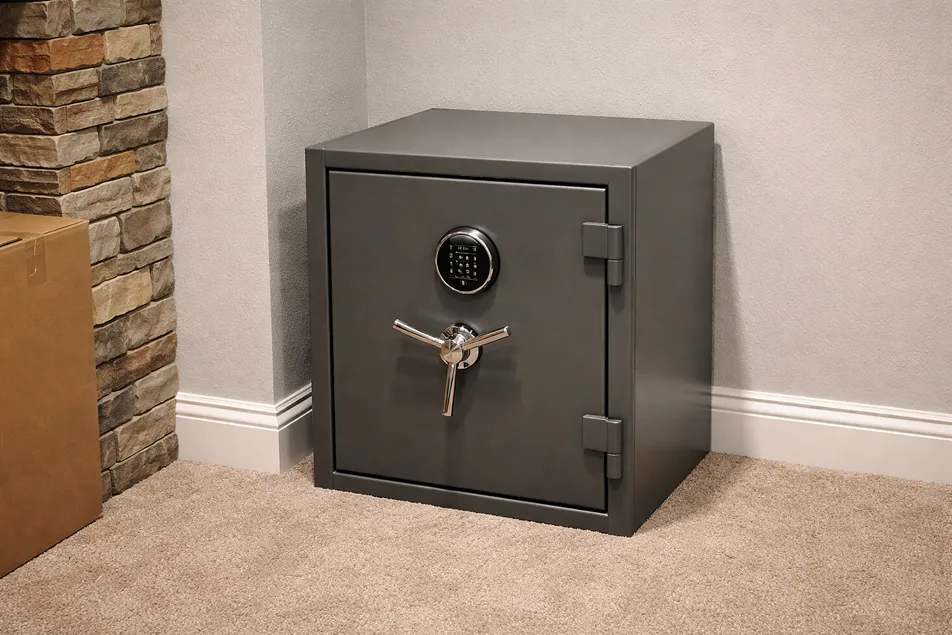
Security is a top concern during data center moves. The risks increase significantly during decommissioning, transit, and handoff between vendors. That’s why the best data center movers treat security as a chain-of-custody problem, enforcing strict protocols at every step.
Key security measures include:
Detailed asset inventory before shutdown
Tamper-evident packaging for all equipment
Documented chain of custody throughout transport
Strict access controls and continuous logging
Encryption for sensitive data in transit
Adherence to leading standards, such as ANSI/TIA-942, ISO/IEC 27001, and NIST guidelines, ensures that physical and logical security are maintained throughout the move. Layered controls, including building perimeter security, entry-point authentication, server-room access restrictions, and rack-level protections, provide comprehensive protection against unauthorized access or tampering.
By prioritizing security, you safeguard not only your IT assets but also your organization’s reputation and compliance posture.
Office Server Moving Tips: Applying Data Center Principles to Smaller Moves
Even small office server moves deserve the same level of rigor as large-scale data center relocations. Treating a server move as a formal project, with clear scope, milestones, and risk controls, can prevent costly mistakes and ensure business continuity.
Start planning your move at least 3 to 6 months in advance.
Create a comprehensive inventory and map out all dependencies.
Handle infrastructure relocation and data migration as separate tasks.
Schedule the move during periods of minimal business impact.
Develop detailed checklists for facility readiness, documentation, and data backups.
By applying these best practices, borrowed from data center movers, you can ensure that even smaller server transitions are smooth, secure, and disruption-free.
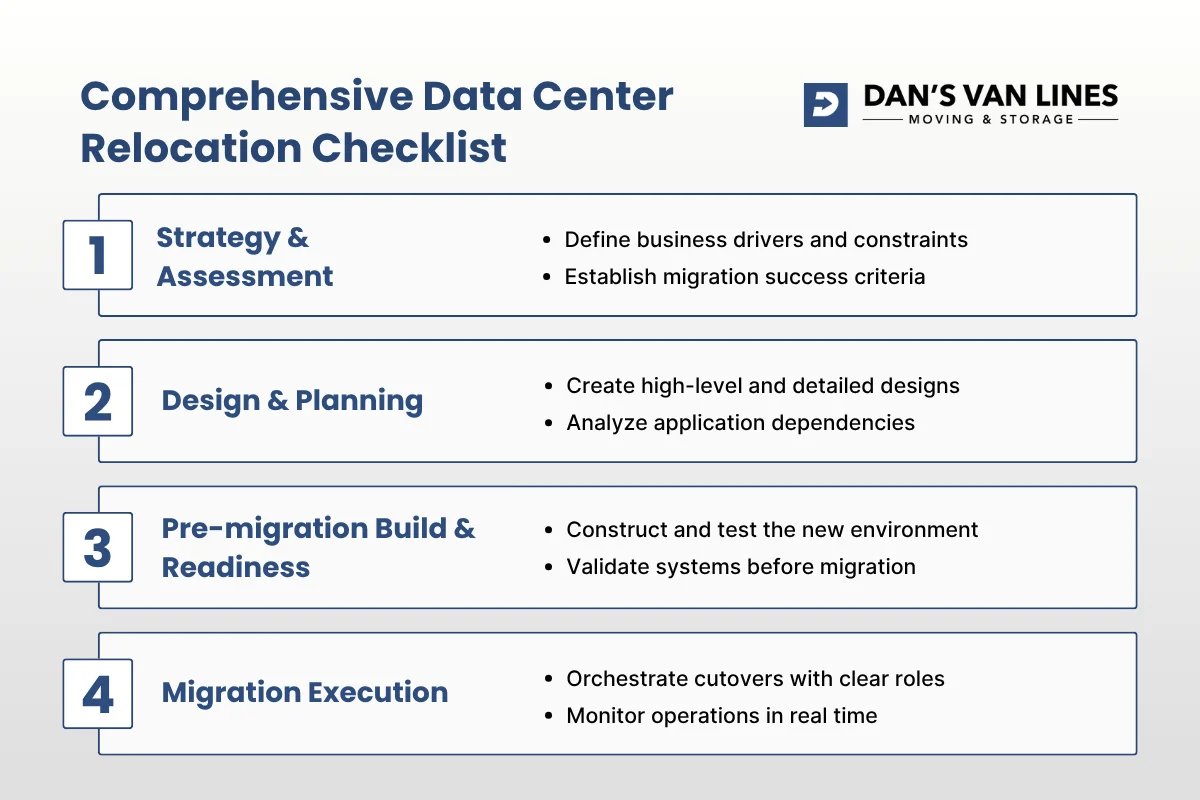
Comprehensive Data Center Relocation Checklist
A successful data center relocation unfolds in five distinct phases, each requiring careful planning and execution:
Strategy & Assessment
- Define business drivers and constraints
Establish migration success criteria
Inventory and classify workloads
Evaluate destination options
Design & Planning
- Create high-level and detailed designs
Analyze application dependencies and sequencing
Select migration methods and risk mitigations
Pre-migration Build & Readiness
- Construct and test the new environment
Validate all systems before migration
Migration Execution
- Orchestrate cutovers with clear roles and rollback triggers
Monitor operations in real time
Post-migration stabilization is an essential phase that follows the migration process. At this stage, it is vital to confirm that all migration objectives have been achieved successfully. You should also focus on properly decommissioning and securing any legacy systems to protect data integrity and uphold security standards. Taking these steps ensures a smooth transition to the new environment and reduces the risks linked to outdated systems.
By following this checklist, you dramatically increase the likelihood of a smooth, risk-mitigated data center move.
Why Choose Professional Data Center Movers?
Relocating a data center is a mission-critical operation that demands experience, technical expertise, and rigorous process discipline. Professional data center movers, like Dan’s Van Lines, bring the following advantages to your relocation:
Decades of hands-on experience with complex IT and server moves
Proven planning and risk management frameworks
Familiarity with industry standards for cabling, labeling, and security
Comprehensive insurance and liability coverage
Trained professionals who understand the unique needs of businesses in Alexandria, VA, and throughout Northern Virginia
Whether you need to move a single rack or an entire data center, partnering with seasoned professionals ensures your assets are protected, downtime is minimized, and your business stays on track.
For additional information on our specialized office and IT equipment moving solutions, view our office moving services.
Plan Your Data Center Move with Confidence
Every data center relocation is a high-stakes event, but with the right expertise and process, it can be a seamless, secure experience. At Dan’s Van Lines, we bring proven reliability, thorough planning, and an unwavering commitment to uptime and security for every move we manage in Alexandria and Northern Virginia.
Ready to ensure your next data center move is handled with the utmost professionalism and care? Get a quote or call us at (703) 553-0900 to discuss your unique project requirements. Our team is here to help your business transition smoothly, without missing a beat.












.webp)
%20(1).webp)
.webp)


.webp)
.webp)
.webp)
.webp)


.avif)
%201.svg)

%201.svg)
%201.svg)