

Moving a piano is unlike moving any other piece of furniture. Whether it’s a cherished upright in your Alexandria home or a grand centerpiece in your Northern Virginia living room, pianos embody both remarkable craftsmanship and substantial investment. Their sheer weight, delicate internal mechanisms, and unique shapes transform even a short move into a high-stakes operation. Mistakes can lead to costly repairs, loss of value, or irreparable damage. This guide uncovers the essentials of how to move a piano safely, blending professional insight with practical steps for homeowners and renters alike.
Here in Alexandria, VA, Dan’s Van Lines are known for dependable local and long distance moving. If you need clarification on anything in this guide, please get in touch.
Understanding Your Piano: Types, Weight, and Structure
The first step in moving a piano safely is knowing exactly what you’re working with. Pianos come in various types, and each demands a tailored approach. The two most common categories are upright pianos and grand pianos, but within these, further variations influence handling and risk.
Upright pianos, including spinets, consoles, and studio models, feature vertical string alignment and a rear soundboard. Spinets stand 36-40 inches tall and weigh about 300-400 pounds. Consoles are slightly taller at 39-43 inches, averaging 450 pounds, while professional studio uprights can reach 60 inches and weigh up to 1,000 pounds. These instruments are top-heavy and prone to tipping, with most of the weight concentrated in the upper half. Improper lifting or tilting can easily destabilize the piano and stress the strings and soundboard.
Grand pianos, from baby grands to concert grands, range from 1.5 to 3 meters in length and can weigh anywhere from 660 to 1,320 pounds. Their horizontal string configuration, exposed lids, and detachable legs mean that moving a grand often requires partial disassembly. The action mechanism and soundboard are particularly vulnerable to uneven pressure and sudden jolts, making specialized handling a necessity. Vintage and antique pianos are especially fragile, while concert grands may require six or more movers due to their size and weight.
Identifying your piano’s type and construction is crucial. This determines the best equipment, team size, and techniques to use. Most DIY damages occur from missteps in this early stage.
Should You Move a Piano Yourself or Hire Professionals?

The risks of moving a piano without professional help are significant. Pianos are not only heavy but also have delicate internal components under immense tension, sometimes up to 20 tons on the strings alone. The decision to DIY or hire pros depends on several key factors, including stairs, tight spaces, distance, and the instrument’s value. Each step or flight of stairs multiplies risk, and doorways or stairwells under 58 inches wide can complicate moves. Local moves differ from interstate or long-distance logistics, and high-value pianos often require certified movers.
Statistics show that amateur piano moves result in 20-30% damage rates, compared to less than 1% for experienced, insured professionals. If your piano’s value, sentimental or monetary, is significant, hiring a specialist is always the safest route. Professional movers like Dan’s Van Lines conduct pre-move audits, measure all potential paths, assess floor conditions, and simulate the move to identify challenges. This approach reduces risk and helps you understand the true cost and logistics before committing.
For those considering a local move within Alexandria or other Northern Virginia communities, our local moving services are equipped to handle even the most challenging piano relocations.
Essential Piano Moving Equipment and Protective Materials
Moving a piano safely is as much about preparation as it is about muscle. The right combination of professional-grade moving equipment and high-quality protective materials shields both your instrument and your home during the relocation process. For grand pianos, piano or skid boards are essential, while heavy-duty dollies are used for uprights. Quilted moving blankets, layered for impact absorption, and plastic wrap to seal against dust and moisture are standard. Residue-free tape secures padding, and corner guards protect vulnerable edges. Pedal and keyboard straps add stability, and power straps allow for controlled lifting. Ramps and floor runners help prevent property damage during the move.
Layered protection is critical. Quilted blankets absorb up to 90% of kinetic energy from bumps and jolts, while plastic wrap keeps out dust and moisture. Properly applied, these measures prevent soundboard cracks, finish scratches, and detuning that can cost thousands to repair. The best results come from sequencing: disassemble where needed, wrap each section individually, and use straps to maintain even pressure during transit. Always use quality materials—cheap pads or tape can fail at the worst moment.
Step-by-Step Process: How to Move a Piano
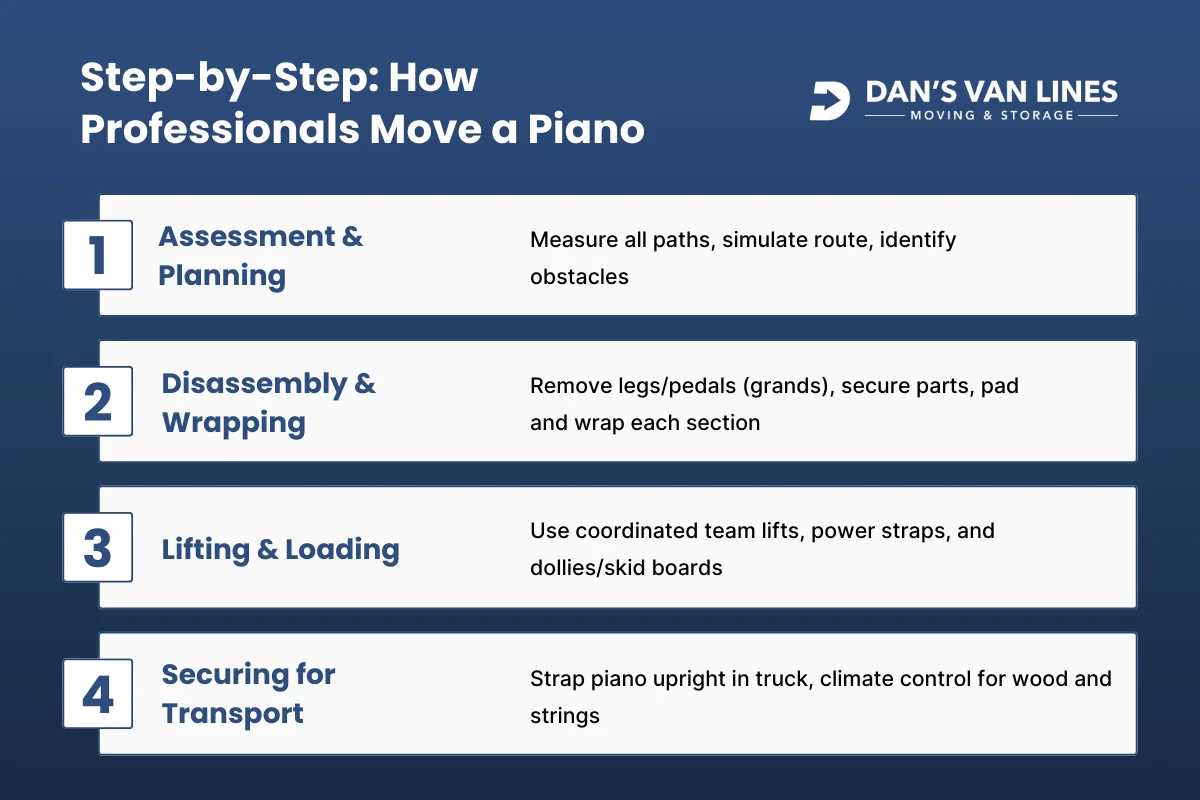
A successful piano move relies on a blend of strong teamwork, expert handling, and precise orchestration. Here’s how professional movers like our team at Dan’s Van Lines approach each move:
Assessment and Planning
We start with an on-site assessment, measuring every doorway, staircase, and hallway along the intended path. This includes simulating the route with the team to anticipate any tight turns or obstacles.
Disassembly and Wrapping
For grand pianos, legs and pedals are carefully removed and individually wrapped. Uprights may need removable parts secured. Each section is padded with moving blankets, wrapped in plastic, and taped for full coverage.
Lifting and Loading
Trained movers, usually four to six for uprights, six or more for grands, use coordinated lifting techniques. Power straps multiply force and reduce injury risk by up to 70%. Uprights are tilted at a 30-degree angle for optimal balance. Instruments are loaded onto the appropriate dolly or skid board and wheeled to the truck.
Securing for Transport
Inside the truck, pianos are placed upright against padded walls. Straps prevent shifting during transit, and climate controls maintain stable humidity and temperature, critical for wood and string health.
Unloading and Reassembly
The process is reversed at your new location. Each part is unwrapped, checked for integrity, and reassembled. Our team ensures the piano is placed on a stable, level surface, away from direct sunlight or HVAC vents to protect its finish and tuning.
Real-time communication among the team prevents torque imbalances and accidents. Having backup equipment on hand ensures there’s no delay in case of unforeseen issues.
Balancing Cost, Quality, and Risks When Moving a Piano

Understanding the cost-quality trade-off is key. While it may be tempting to save money with a low-cost, uninsured mover, or by attempting a DIY move, the risks often outweigh any potential savings. Repairing a damaged piano can cost far more than hiring professionals in the first place.
Here’s what to expect for piano moving costs: Room-to-room moves typically range from $150 to $350, depending on type and complexity. Local moves are usually $150 to $650, including one flight of stairs. Grand pianos cost more, often $350 to $900, due to their complexity. Long-distance moves can range from $450 to $2,300 or more, depending on distance and climate controls. International moves require crating and customs fees, with costs from $2,000 to $5,000. Additional surcharges may apply for stairs, tight spaces, or complex disassembly. Grand pianos often cost 30-50% more to move than uprights. Always ask about insurance and certifications, as uninsured movers expose you to losses upwards of $10,000 if things go wrong.
At Dan’s Van Lines, we provide detailed quotes with a built-in buffer for unforeseen challenges. Our team’s professional training and experience mean your piano is protected every step of the way, preserving its value and giving you peace of mind.
Post-Move: Tuning and Caring for Your Piano
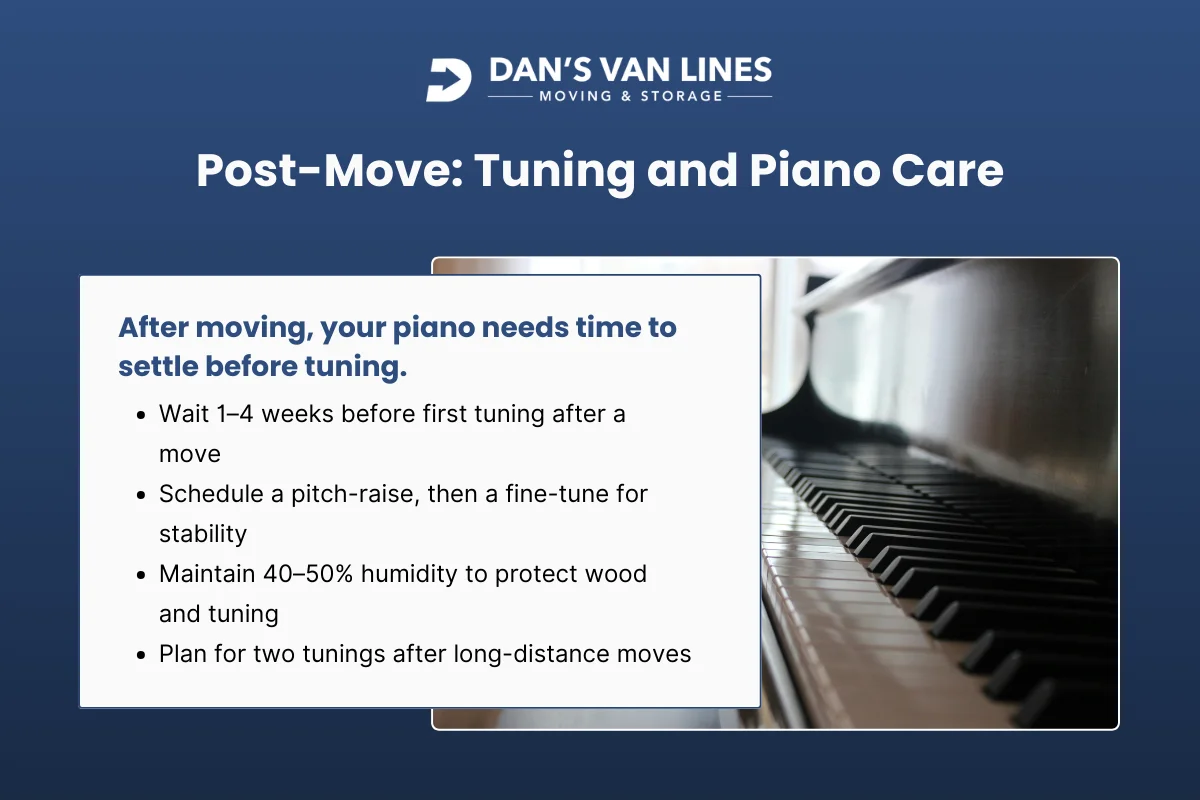
After a move, your piano needs time to adjust. The stress of transportation, changes in humidity, and shifts in gravity often cause a piano’s pitch to drop by a quarter to a full tone. Tuning too soon can be ineffective as the instrument continues to settle. Wait one to four weeks after moving before the first tuning, then schedule a pitch-raise followed by a fine-tune. Repeat tuning after two to three months for stability. Maintain relative humidity between 40-50% to protect wood, and plan for two tunings after long-distance moves. Monitoring your home’s humidity and temperature helps prevent further tuning drift and extends your piano’s lifespan. Regular care after moving will keep your instrument sounding its best and guard against action wear or false partials.
Why Choose Dan’s Van Lines for Piano Moving in Northern Virginia?

With over 25 years of experience moving pianos across Alexandria and the greater Northern Virginia area, Dan’s Van Lines understands the unique demands and value of your instrument. Our expert movers, specialized equipment, and comprehensive insurance protect your piano from start to finish. We serve homeowners, renters, and businesses alike, whether you’re relocating across town, moving long-distance, or need secure warehouse storage for your piano during a transition. Our team is committed to professionalism, efficiency, and outstanding customer care.
If you’re planning a move in Alexandria or elsewhere in Northern Virginia, contact Dan’s Van Lines to see how we can help make your piano relocation seamless and stress-free.























.webp)
%20(1).webp)
.webp)

.webp)
.webp)
.webp)
.webp)




.avif)
%201.svg)

%201.svg)
%201.svg)